
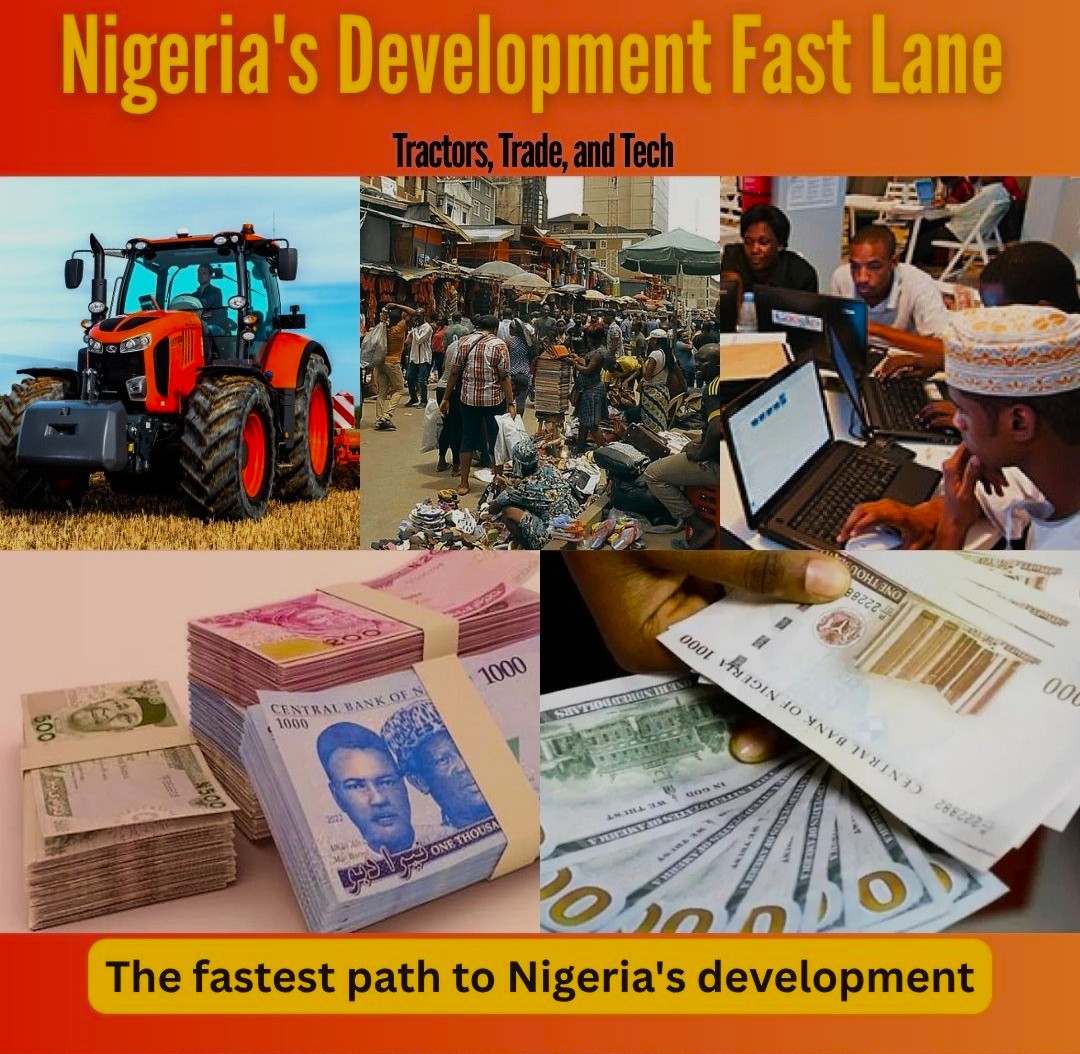
Nigeria’s development is a story of real potential meeting real frustration. The country is Africa’s largest economy. It has the continent’s biggest population, some of its most creative minds, and more arable land than most nations could dream of. Yet the World Bank says Nigeria needs to grow roughly five times faster just to reach a $1 trillion GDP by 2030.
That is the uncomfortable gap between ambition and reality.
The National Bureau of Statistics confirmed that Nigeria’s economy expanded by 3.89% in real terms in Q1 2026. That outpaces the 3.13% growth recorded in Q1 2025. Progress, yes. However, with inflation at 33.2% in 2024, more than 63% of the population living on under $3.65 a day, and the naira losing 42% of its value in a single year, growth numbers alone are not feeding families or building industries.
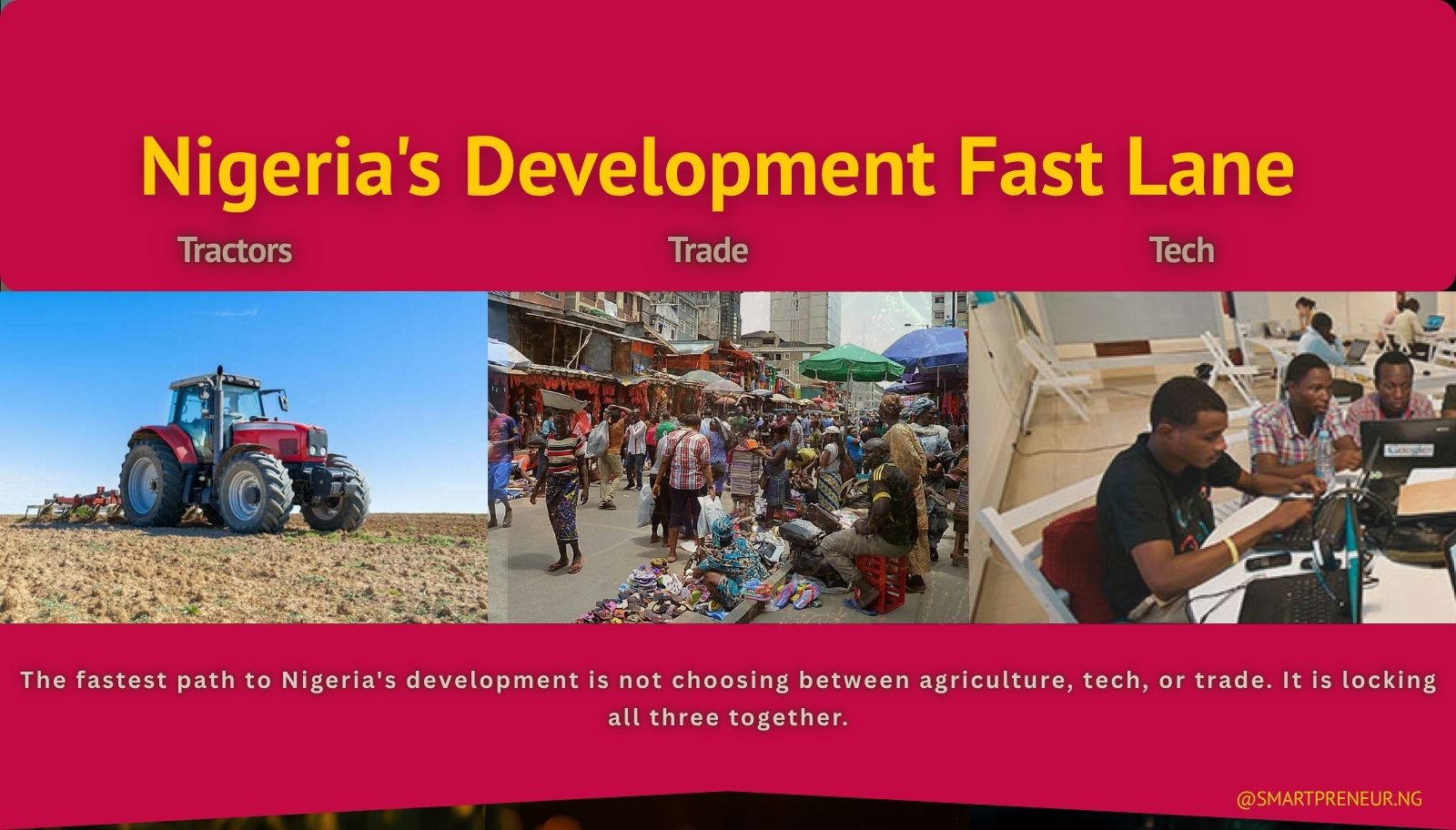
So what would actually move the needle? Three things, done at the same time: trade integration, mechanised agriculture, and science and technology. Not as separate policy goals pulling in different directions, but as one interlocked engine. The fastest version of Nigeria’s development is a tech-enabled, mechanised agricultural supply chain built for global commerce.
Here is what the data shows.
Nigeria’s Development Problem with Trade: A ₦7.55 Trillion Surplus on Shaky Ground
Nigeria’s trade numbers in 2026 look strong on the surface. The NBS reported that Nigeria’s foreign trade surplus surged by 341% to ₦7.55 trillion in Q1 2026. Total exports hit ₦21.169 trillion. That is not a small achievement.
But crude oil still accounts for 52.92% of total export volume. Strip that out, and the picture shifts quickly. The country is heavily dependent on one commodity it does not fully control, priced in a currency it does not issue, sold to buyers it cannot afford to lose.
AfCFTA: A Real Opportunity Nigeria Is Still Slow to Grab
The AfCFTA framework changes the strategic equation — if Nigeria actually commits to it. Notably, the African Union designated Nigeria as the Digital Trade Champion for the continent at the AU Summit in February 2025. Furthermore, intra-African trade exports grew by over 13% in 2025, supported by new trade corridors. Nigeria’s non-oil exports also grew 24.75% in Q1 2025 alone, driven by agriculture, solid minerals, and value-added goods.
Nigeria has already exported ceramics, garments, pharmaceuticals, cables, and smart cards to Egypt, Algeria, Uganda, Cameroon, and Kenya under the AfCFTA framework. Moreover, the recent launch of the Nigeria Trade Intelligence Report 2025, the opening of a dedicated air cargo corridor to East Africa, and the acceleration of the National Single Window for trade are all pointing in the right direction.
The Real Shift Has Not Happened Yet
Despite these wins, Nigeria is still largely exporting raw inputs rather than finished goods. Building out processed agricultural exports — packaged cocoa, cashews, starch, palm derivatives — is how a ₦7.55 trillion surplus becomes a structural feature of the economy rather than a one-off quarterly result.
That requires what happens in the next section.
Related SMEDAN Trains Smartpreneurs to Attract Investment
African Literature and AI Development: Ownership and Representation
Nigeria’s Development Bottleneck: The $6 Billion Agricultural Deficit
Agriculture employs approximately 70% of Nigeria’s rural population. In addition, it contributed 22.6% to GDP in real terms in 2024. It is the backbone of Nigeria’s development. And it is running on tools that have barely changed in generations.
The International Trade Administration notes that Nigeria continues to run an agricultural trade deficit, importing over $6.6 billion in agricultural products annually. A country with Nigeria’s land mass and farming population importing this volume of food is not just an economic problem. It is a development failure that demands a direct answer.
The Numbers Behind the Gap
Less than 20% of farmers have access to mechanisation. Cereal crop yields reach only about 25% of their full potential. In addition, in 2024 alone, floods destroyed approximately 700,000 hectares of farmland across the country.
On the positive side, the Greener Hope National Agriculture Mechanisation Programme has deployed 2,000 tractors. However, this falls well short of the 10,000 units promised over five years. Agriculture expanded 4.0% in Q4 2025, up from 2.54% in the same period of 2024. Improved security in food-producing regions and better access to inputs drove this uptick. Nigeria also became the second African country to approve biotech maize engineered for drought tolerance and insect resistance.
What Mechanised Agriculture Actually Needs
These are real steps. But the pace is still too slow for a population of 220 million that needs food, jobs, and export revenue at the same time.
In practice, mechanised agriculture requires tractors linked to leasing systems that smallholder farmers can access without collateral they do not have. It also needs irrigation infrastructure that reduces the gamble on rainfall. Cold chain networks must stop post-harvest losses from eating up to 40% of output before it reaches a buyer. Agro-processing plants need to be built near farming communities, not in distant cities. And financial platforms must connect farmers to credit in real time.
The $538 million invested in Nigeria’s Special Agro-Industrial Processing Zones is a framework worth building on. Furthermore, cold chain infrastructure across Africa is projected to grow from $10.88 billion in 2024 to $14.85 billion by 2029. Nigeria should be anchoring that growth, not watching it from the side.
Nigeria’s Development Engine: Science and Technology Beyond Fintech
Between 2019 and 2025, Nigerian startups raised approximately $5.07 billion in venture funding. That confirms Nigeria’s position as Africa’s premier tech hub. However, where that money went tells a less comfortable story.
The Fintech Concentration Problem
Fintech captured 72% of Nigeria’s startup funding in 2024. Lagos now hosts over 430 fintech companies, up 70% from 255 in January 2024. That is 28% of all African fintech companies despite representing only 15% of the continent’s population. The fintech sector processed 1.07 quadrillion naira — roughly $753 billion — in electronic payments in 2024. Moniepoint raised $110 million and became a unicorn. The sector is real, large, and producing results.
Yet agriculture, manufacturing, logistics, health tech, climate tech, and education technology are all competing for the remaining 28% of funding. Meanwhile, global investor appetite is shifting. Fintech’s share of African equity funding dropped from 60% in 2022 to 25% in 2025. Kenya’s clean-energy startups captured 83% of Africa’s $550 million in startup funding in July 2025 alone. Nigeria was barely part of that conversation.
The iDICE Opportunity and the Power Crisis
The iDICE project is one of the more credible structural interventions on the technology side. It is projected to generate $6.4 billion in economic value. Furthermore, it aims to train over 250,000 young Nigerians in market-ready technical skills, with innovation hubs scaling across the federation. That is the kind of human capital investment that feeds every other sector — from agritech platforms to logistics software to supply chain tracking.
Electricity: The Invisible Tax on Everything
The problem that no amount of startup funding solves on its own is electricity. Nigeria generates roughly 4,000 megawatts for 220 million people. By contrast, Germany generates over 80,000 megawatts for 84 million. Running a serious technology economy on generators is not a workaround. It is a structural ceiling. Until power is fixed, every other investment operates at a permanent discount.
Brain drain compounds this further. Talented founders are incorporating offshore in Delaware or Mauritius. Engineers are leaving. Designers are working remotely for firms in London and San Francisco. The Japa wave is not just a social trend. It is capital, skills, and innovation leaving the country at the same time.
The Convergence: Where Nigeria’s Development Actually Accelerates
The honest argument is not that trade, mechanised agriculture, and technology each independently develop Nigeria. Instead, none of them works properly without the other two.
Technology without mechanised agriculture means fintech dominance and agritech starvation. Mechanised agriculture without trade infrastructure means farmers produce more food that still cannot reach profitable markets. Trade without domestic production diversification means a surplus built on crude oil that any price shift can erase overnight.
How the Three Pillars Reinforce Each Other
The multiplier happens when they interlock. Smart tractors and automated equipment replace hoes and cutlasses, cutting labour costs and saving time. Agritech platforms layered on top give farmers real-time weather analytics, certified input suppliers, and transparent leasing systems. Logistics software and B2B payment solutions built by local tech talent move goods across rural corridors without severe inventory loss. Finally, trade frameworks like AfCFTA create the markets where processed Nigerian goods — not raw commodities — are priced at their actual value.
How the Three Sectors Compare
The table below shows how each sector performs as a standalone development lever.
| Sector | Development Speed | Capital Efficiency | Structural Scalability |
|---|---|---|---|
| Trade and Commerce | Fast — immediate liquidity | Moderate — highly volatile | Dependent on global shipping markets |
| Advanced Mechanised Agriculture | Moderate — takes time to yield | Low — high initial capital cost | Massive domestic baseline expansion |
| Science and Technology | Explosive — scales quickly | High — digital cost efficiencies | Virtually unlimited |
No single column wins outright. The fastest and most durable path to Nigeria’s development runs through all three at once.
The Honest Verdict on Nigeria’s Development
Nigeria’s macro trajectory is genuinely improving. Revenue is up. External balances are better. The oil sector grew 6.79% year-on-year in Q4 2025. Q1 2026 economic growth has outpaced Q1 2025. These are real signals worth acknowledging.
However, the average Nigerian has not felt this yet. Food inflation is still punishing. Poverty remains widespread. A ₦7.55 trillion trade surplus means very little if the majority of that surplus evaporates the moment crude oil prices dip.
What Nigeria Must Do Next
The fastest version of Nigeria’s development is not a debate between three good options. It is the decision to build all three simultaneously and make them work together. Tech infrastructure that runs mechanised farming yields. Mechanised agriculture that gives trade something valuable to export. Trade frameworks that create the demand for what farms and factories actually produce.
Nigeria has the land, the people, the frameworks, and now the data to make this case clearly. What remains is execution at scale and the political will to hold the pressure until ordinary Nigerians can actually feel the growth that the GDP numbers already claim.
That is the only version of Nigeria’s development worth talking about.


