

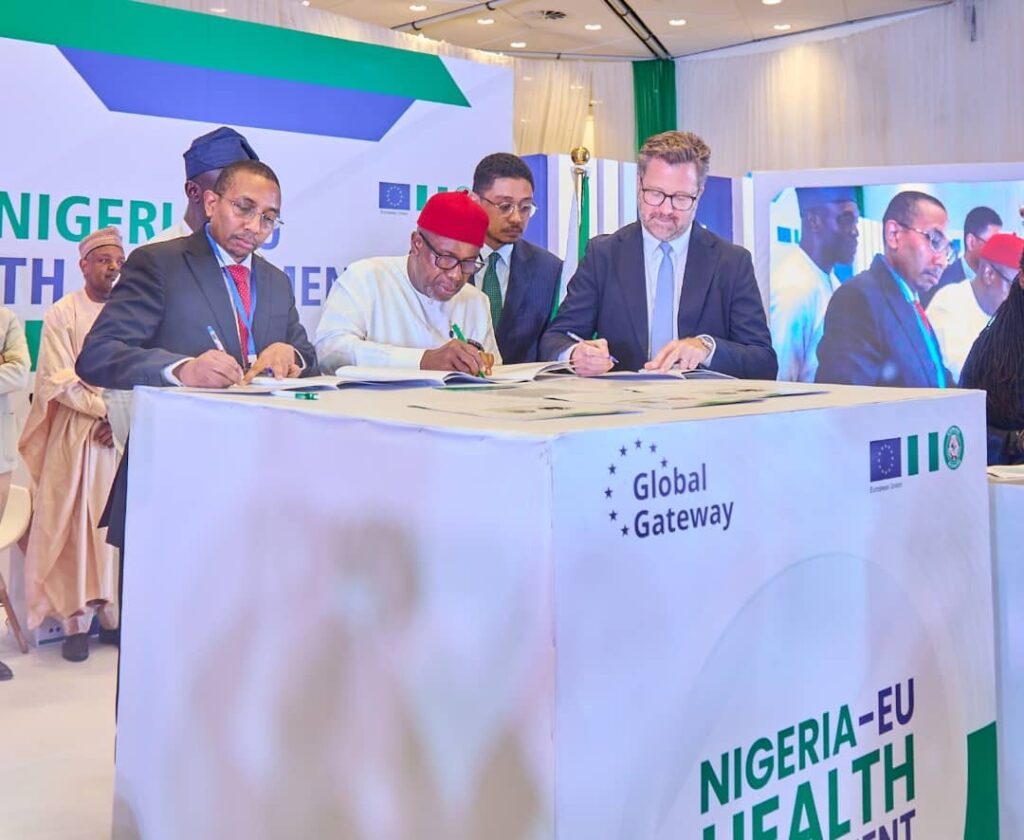
In a bold and timely move, the Nigerian Government, in partnership with the European Union (EU) and France, has officially launched a €10.2 million pharmaceutical manufacturing empowerment initiative aimed at strengthening Nigeria’s local capacity for producing essential medicines and vaccines.
The announcement was made on 3 November 2025 at the Nigeria-EU Health Investment Forum held in Abuja, marking a significant step in boosting Nigeria’s health sector, economic growth, and job creation.
What the Initiative Entails
Under the banner “Quality Uplift for Advancing Local Industry in Medicine Standards,” this project will run from 2025 to 2028, spanning 44 months. It is a central pillar of the EU’s Global Gateway MAV+ program, which seeks to broaden access to vital health technologies in developing countries.
Key components include:
- Upgrading manufacturing standards to support local pharma firms to achieve Good Manufacturing Practice (GMP) compliance and meet international quality benchmarks.
- Innovation and R&D support to encourage adoption of new technologies, formulation research, and product development.
- Capacity building & workforce training to equip professionals in the sector with the skills and know-how to run modern pharmaceutical operations.
- Lab modernization & advanced testing to boost local laboratories’ capacity for quality assurance, certification, and regulatory oversight.
- Market expansion & regional integration to position Nigerian manufacturers to scale into regional and global value chains.
Related: British Council and SMEDAN Launch Impact Advisory Group to Improve MSME Financing
Voices Behind the Project
Gautier Mignot, EU Ambassador to Nigeria and ECOWAS, emphasized the broader goals: “We want to make healthcare in Nigeria sustainable, diversified, accessible, and affordable for all, while creating jobs and opportunities.”
Marc Fonbaustier, France’s Ambassador, framed the partnership in terms of equity and shared development, noting France’s long-term commitment to reinforcing local health systems.
Dr. Obi Adigwe, Director-General of the National Institute for Pharmaceutical Research and Development (NIPRD), described the initiative as a catalyst for technology transfer, competitiveness, and commercial opportunities for local SMEs. “This is about improving access while driving job creation, capacity building, and revenue growth,” he said.
Why This Matters for the Nigerian Health Economy
- Reducing import dependency: Nigeria currently imports a large share of its medicines and raw materials. This initiative aims to shift Nigeria toward self-sufficiency in essential drug production, reducing vulnerabilities in supply chains.
- Opportunities for pharma SMEs and startups: Local pharmaceutical firms and biotech startups now have a stronger chance to tap into funding, technical partnerships, regulatory support, and market access under this program.
- Job creation & skills development:By investing in lab modernization, quality control, and training, the project will strengthen human capital in the pharmaceutical and health technology space.
- Access & affordability for Nigerians: When production is local, costs can potentially come down. This project is positioned to improve access to quality medicines for millions of Nigerians.
- Regional export potential: Meeting international quality standards opens doors to export into West Africa and across the African continent — expanding markets beyond domestic demand.
This €10.2 million initiative is more than just financial backing. It signals a strategic pivot: Nigeria, the EU, and France are rolling up their sleeves to build a resilient, self-reliant pharmaceutical sector in Nigeria. For SmartPreneurs, this is a moment loaded with possibility whether you’re in pharma, biotech, health tech, or supply chain to participate, pitch, innovate, and fulfill a vital national mission.


