
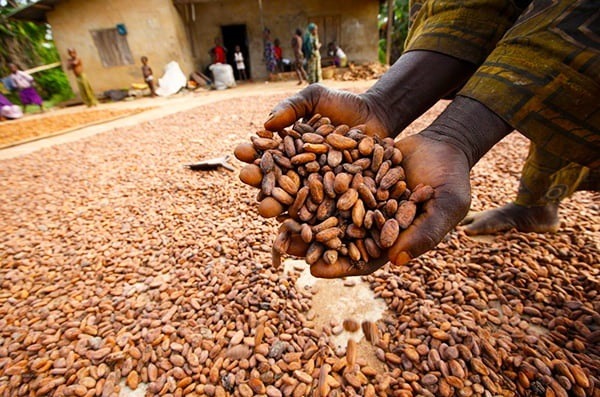
In a bold move, cocoa farmers in the forest reserves of Idanre and Akure have formally protested the recently announced forest-farming policy of the Ondo State government, arguing it threatens the livelihood of thousands of smallholder producers in Nigeria’s cocoa belt.
The farmers, under the leadership of their legal counsel, Olugbenga Oke‑Samuel of Lawville Legal Practice, Akure wrote a letter dated October 30, 2025, addressed to Governor Lucky Aiyedatiwa’s administration. In it, they decry the requirement that cocoa farmers operating in forest reserves must pay N250,000 per hectare for a permit that lasts only five years. The fee is broken down as N150,000 for “polygon mapping” and N100,000 for agro-forestry compliance in line with the European Union Deforestation Regulation (EUDR).
The farmers say the timing is especially harsh. They note that cocoa prices in Ondo State have dropped from about N14,000 to N6,000 per kilogramme, a challenging margin for smallholders already operating on slim profits. MSME Africa Additionally, the state’s Ministry of Agriculture recently increased the cocoa grading fee from N11,000 per tonne to an equivalent of N22,000 per kilogramme or roughly N660,000 per trailer adding further pressure.
“Our members are smallholders. They are being asked to shoulder costs that even big investors will struggle with,” the petition claimed.
Related: Clean Technology Opens New Revenue Streams for Nigerian MSMEs
Why the farmers say it’s unfair
Under the previous system, smallholders paid about N20,000 per hectare for environmental compliance. The sudden jump to N250,000 per hectare is, according to the farmers, unsustainable. They pointed out that exporters in non-forest communities currently carry out mapping for free and even offer incentives, while smallholders in forest zones are being charged.
On the agro-forestry levy of N100,000: farmers argued it’s unrealistic, noting that seeds for 1,000 trees cost only around N5,000 raising questions about equity and transparency.
Another major concern: the five-year permit ceiling. Cocoa trees typically produce for over 40 years, yet smallholders are limited to five years, while large investors reportedly get long-term leases at much lower per-hectare rates. For example:
- JB Farms Ltd got a 50-year permit for 14,000 ha at N3,572 per hectare annually
- SAO Agro Ltd got an 80-year permit for 10,000 ha at N2,000 per hectare
- Tropic Palm Oil Ltd got a 40-year permit for 14,000 ha at N2,150 per hectare
In the view of the farmers, it’s a clear case of “one rule for smallholders, another for big investors.”
What the farmers want
In their petition, the smallholder cocoa farmers make the following demands:
- Review the N250,000 per hectare charge, bringing it closer to what smallholders can afford.
- Extend permit duration for small cocoa farmers to at least 50 years, aligning more realistically with the productive lifespan of cocoa trees.
- Subsidise or waive polygon-mapping fees for smallholders, given the heavy cost and technical demands.
- Align agro-forestry charges with actual market cost of tree planting and ensure transparency in what the fees are funding.
They appeal to the Governor and the state government to act “in the interest of fairness and economic justice.”
What this means for entrepreneurs and agri-business
For agripreneurs and cocoa-value chain players, this development carries several implications:
- Smallholder risk increases: Rising fixed costs and shorter permit durations could deter investment at the grassroots, limiting cocoa supply or forcing consolidation by larger players.
- Opportunity for support services: Mapping, compliance and agro-forestry services may become a niche for startups to support smallholders in meeting these new requirements.
- Supply chain transparency: With EUDR and global buyers demanding deforestation-free cocoa, compliance costs will rise—making quality, traceability and sustainability even more critical.
- Policy-risk awareness: Entrepreneurs entering the cocoa sector in forest reserve zones must factor in regulatory shifts, permit issues, and potential protests into their business models.
The protest by cocoa farmers in Ondo State underscores a tension between sustainability-driven regulation and the livelihoods of smallholder producers. As the state government implements its forest-farming policy, the response from those most affected signals a need for balance: protecting forests and complying with global standards, while ensuring smallholders are not unfairly burdened. For smart entrepreneurs in Nigeria’s agribusiness sector, this is a moment to listen, adapt and find solutions that link sustainability with inclusive growth.


