
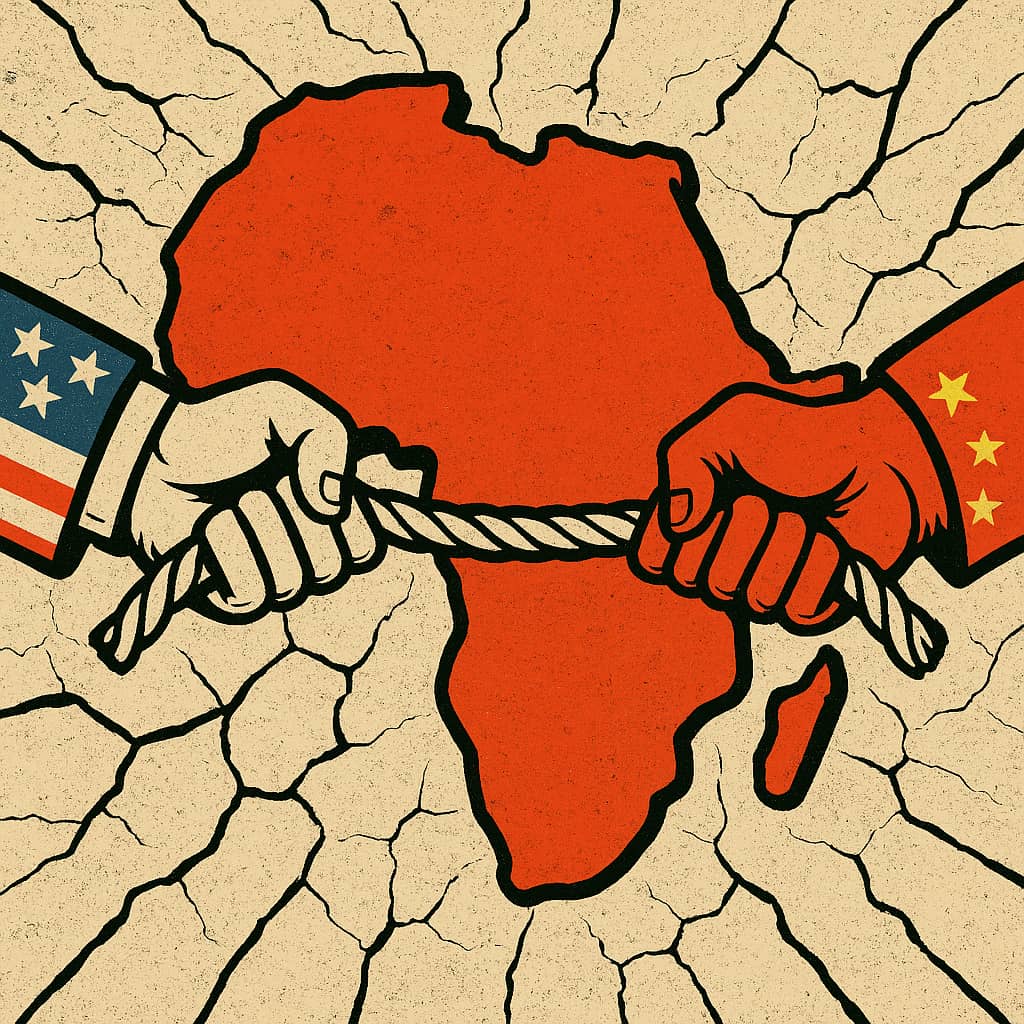
“When two giant elephants fight, the grass suffers.” — African Proverb
In 2025, the U.S.-China tariff war has intensified into one of the most disruptive economic stand-offs in modern history. With both countries slapping tit-for-tat tariffs, some as high as 145% on billions of dollars’ worth of goods, the global economy is once again bracing for impact. While these economic behemoths wrestle for dominance, the shockwaves are being felt far beyond Washington and Beijing, rippling across continents and hitting some of the world’s most vulnerable economies, especially in Sub-Saharan Africa.
The U.S.-China Trade War: A Global Quake
The tariff battle, reignited under President Trump’s second term, has led to a sharp increase in costs for businesses and consumers in both countries. China has responded by not only imposing counter-tariffs but also restricting the export of rare earth minerals, a critical blow to global tech manufacturing.
This titanic clash has strained global supply chains, slashed investment flows, and depressed commodity prices. While the U.S. and China try to shield themselves with protectionist policies and economic stimulus packages, smaller economies have no such luxury. Countries like Nigeria, Kenya, Ghana, and Ethiopia are feeling the fallout, some directly, others indirectly.
Related: https://smartpreneur.ng/when-it-is-too-good-it-is-ponzi/
How It Affects Nigeria and Sub-Saharan Africa
1. Oil-Dependent Economies Under Pressure
Nigeria, Africa’s fourth-largest economy, is heavily dependent on oil exports, which account for over 90% of its foreign exchange earnings. As Chinese factories scale back due to decreased exports to the U.S., demand for oil has dropped globally. Crude prices have fallen by 17% in the first quarter of 2025, according to the International Energy Agency (IEA), shrinking Nigeria’s revenue base and threatening its ability to fund public services.
2. Inflation and Currency Devaluation
With capital flight to safer economies like the U.S., Nigeria’s naira has depreciated by 13% in early 2025. This has driven up the cost of imports, from food to medicine and industrial equipment. Inflation, already high at 31.7%, continues to climb, eroding consumer purchasing power and deepening poverty levels. Other Sub-Saharan economies with import dependencies face similar fates.
3. Drop in Foreign Investment
The global uncertainty triggered by the tariff war has made investors more risk-averse. According to UNCTAD, FDI into Sub-Saharan Africa fell by 25% in early 2025, with tech and infrastructure projects being postponed or cancelled altogether. This has disproportionately affected growth economies like Kenya and Ghana, which rely heavily on external capital for development.
4. Export Market Disruptions
African exports of raw materials and agricultural products are taking a hit. China, a major importer of African minerals, has slowed its buying to conserve foreign reserves. Zambia’s copper exports, for example, declined by 14%, while cocoa prices from Côte d’Ivoire dropped by 8%. This threatens both national income and millions of livelihoods tied to farming and mining.
5. Debt and Aid Uncertainty
Both the U.S. and China are major lenders to African governments. With their economies under pressure, concessional loans and development aid are being reevaluated. Countries like Ethiopia, heavily indebted to China, are facing uncertainty over future infrastructure financing. Meanwhile, U.S.-funded aid programs may also face cuts as Washington prioritizes domestic economic protection.
Any Silver Linings?
A few countries may find limited opportunities in the chaos. Nations like Rwanda and Senegal are trying to position themselves as alternative trade hubs or light manufacturing zones for Western markets seeking to pivot away from China. However, these are long-term shifts that require massive investment in logistics, policy reform, and infrastructure — things many Sub-Saharan countries are still struggling with.
Conclusion
The U.S.-China tariff war may be driven by nationalist economic ambitions, but it is exacting a heavy toll on the rest of the world. For Nigeria and its neighbours, the effects are not just about slowed trade — they are about real people facing job losses, food inflation, and an uncertain future.
Some wars are not fought with guns and bombs but with a reckless pen.


